Industrial Digital Assets
Computational platforms that integrate technical models, operational data, and business logic to enable confident decision-making under uncertainty.
The Decision Fragility Problem
Industrial assets operate at the intersection of thermodynamic constraints, reliability uncertainty, and volatile market conditions. Traditional decision-making tools—spreadsheets, isolated reliability models, and disconnected financial analyses—cannot capture the causal dependencies between equipment performance and business outcomes.
The result: Decision Fragility—where capital deployment, maintenance timing, and configuration choices are made with incomplete information, leading to missed opportunities, overdesign, or catastrophic losses.
The Question
What happens if a critical compressor fails during peak production season?
The Question
How do we balance the cost of redundancy against the risk of contractual penalties?
The Question
Which maintenance strategy maximizes EBITDA over the next 10 years?
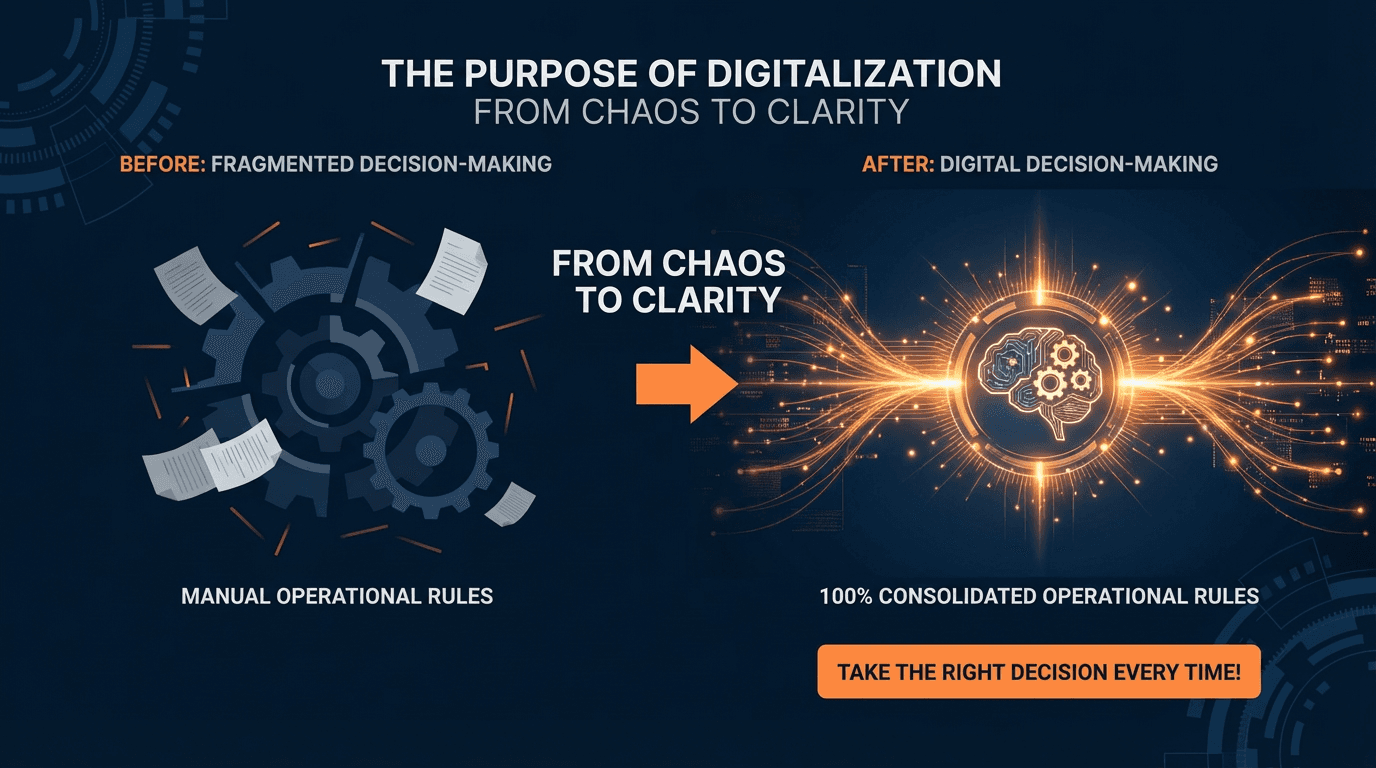
Industrial Digital Assets provide the answer by integrating physics, reliability, and economics into a single computational platform.
What Is an Industrial Digital Asset?
An Industrial Digital Asset (IDA) is a computational platform that integrates technical, operational, financial, and risk models into a unified system—enabling you to answer the question: "What action maximizes business value across the asset lifecycle?"
An IDA evolves with your physical asset, simulating thousands of scenarios, linking equipment health to EBITDA impact, and supporting confident action even when conditions are complex.
It integrates:
- ▸Reliability & Maintainability Models — failure distributions, degradation curves, maintenance effects
- ▸Process & Control Data — real-time operations, historians, configuration states
- ▸Market & Contractual Context — price curves, delivery obligations, contract terms
The result: a living system that enables scenario exploration and optimization, serving as a single source of truth across engineering, operations, finance, and strategy.
What an Industrial Digital Asset Delivers
Causal Integration Across Domains
Maps how equipment failure propagates to system unavailability, production loss, and EBITDA impact using PDEL® (Performance Dependency Elucidation Language)—ensuring full traceability from sensor to P&L.
Probabilistic Simulation & Forecasting
Runs Monte Carlo simulations across multi-year horizons with P50, P80, P90 confidence intervals, forecasting availability under feed variability, market volatility, and maintenance constraints.
Scenario Exploration & Optimization
Enables exploration of thousands of configurations, operational modes, and maintenance strategies using MiRO v1 (Minimizer of Operational Risk) to identify optimal risk-reward trade-offs.
Risk-Aware Decision Architecture
Quantifies trade-offs between redundancy cost, reliability risk, and contractual penalties—delivering actionable insights with explicit uncertainty bounds, not just deterministic outputs.
Living Knowledge Repository
Continuously updated with real-world performance data, model refinements, and operational rules—growing more accurate over time and serving as permanent institutional memory.
Lifecycle Value Maximization
Links technical decisions to financial outcomes across the full asset lifecycle, enabling capital allocation, maintenance timing, and configuration choices that maximize NPV and IRR.
Proven Results: Industrial Digital Assets in Action
Major Gas Processing Facility
Mid-Stream Oil & Gas | North America
Challenge
A large gas processing facility managing dry and wet gas compression systems needed to evaluate mixed-mode operations, optimize compressor configurations, and link technical decisions to EBITDA impact under volatile market conditions.
IDA Implementation
- Integrated Weibull reliability models for 18 compressor units and critical auxiliary systems
- Simulated 500+ operational scenarios over five-year horizon using Monte Carlo methods
- Applied MiRO v1 optimization to identify configurations minimizing operational risk
- Linked equipment performance to contractual delivery obligations and penalty structures
- Modeled spare parts logistics and maintenance crew availability constraints
The IDA continues to support capital allocation, maintenance scheduling, and real-time operational decisions.
Chemical Manufacturing Complex
Specialty Chemicals | Latin America
Challenge
Multi-unit chemical plant facing recurring unplanned shutdowns due to heat exchanger fouling, reactor catalyst degradation, and feed composition variability—resulting in $30M+ annual production losses.
IDA Implementation
- Integrated thermodynamic models, degradation curves, and real-time process historian data
- Modeled causal dependencies between feed quality, catalyst life, and product yield using PDEL®
- Simulated 1,000+ maintenance intervention strategies under market price volatility
- Quantified trade-offs between production throughput and quality-adjusted margins
Client anonymized per NDA. Metrics verified through 24-month post-implementation tracking.
Tools & Methods
Software Platforms
- • Reliability modeling tools (AspenTech Fidelis, custom frameworks)
- • MiRO v1 optimization engine
- • PDEL® causal modeling language
- • Process simulation platforms
Methodologies
- • Markov state modeling
- • Multi-variate sensitivity analysis
- • Integrated physics-statistics frameworks
- • Uncertainty quantification
Deliverable
An executable decision-support platform used daily by engineering and operations teams—not a static report, but a living tool that supports ongoing value generation.
Frequently Asked Questions
How is an Industrial Digital Asset different from a digital twin?
A digital twin typically replicates physical behavior in real-time for monitoring and diagnostics. An Industrial Digital Asset goes further: it integrates reliability models, operational constraints, market data, and financial outcomes into a unified decision platform. Where a digital twin answers "what is happening?", an IDA answers "what should we do?" by quantifying trade-offs across physics, risk, and economics.
What industries benefit most from Industrial Digital Assets?
IDAs deliver the highest value in capital-intensive process industries where equipment reliability directly impacts production capacity and contractual obligations. This includes oil & gas (upstream, midstream, downstream), mining & minerals processing, chemical manufacturing, power generation, and renewable energy infrastructure. Any operation with high-consequence failure modes, complex system dependencies, and significant market exposure benefits from IDA-based decision architecture.
What is PDEL® and why does it matter?
PDEL® (Performance Dependency Elucidation Language) is Knar's proprietary methodology for formalizing causal relationships between equipment states, system performance, and business outcomes. It ensures that every reliability model, process constraint, and operational rule is traceable to its impact on production, cost, or revenue. PDEL® prevents "black box" modeling by making all assumptions, dependencies, and logic explicit and auditable—essential for high-stakes industrial decisions.
How long does it take to build an Industrial Digital Asset?
Implementation timelines vary by asset complexity and data availability. A focused IDA for a single production train or critical system typically requires 3-6 months from kickoff to operational deployment. Large-scale implementations spanning multiple facilities or integrated value chains may extend to 9-18 months. We follow a phased approach: first 90 days focus on one high-impact decision, validate results, then expand scope systematically.
What data is required to build an IDA?
Minimum requirements include: equipment failure history (CMMS data), process operating conditions (historians, SCADA), maintenance records, and business context (production targets, contractual obligations, cost structures). Ideal datasets include design documentation, vendor reliability data, and existing RAM studies. We work with imperfect data—Bayesian updating and expert elicitation fill gaps where historical data is sparse. Data quality improves as the IDA evolves and learns from operations.
Can an IDA integrate with existing systems (ERP, CMMS, historians)?
Yes. IDAs are designed to integrate with enterprise systems including SAP, Oracle ERP, Maximo, IBM Tririga, OSIsoft PI, Honeywell PHD, and other SCADA/historian platforms. Integration can be real-time (API-based) or batch (scheduled data pulls), depending on operational needs. The IDA serves as the decision layer on top of existing data infrastructure—it doesn't replace ERP or CMMS, it makes them more valuable by linking operational data to strategic outcomes.