
KIAME
Knar Industrial Asset Management Enforcement Framework
KIAME's founding premise departs deliberately from conventional guidance frameworks such as ISO 55000, which describe principles and desirable outcomes but stop short of mandating the formal modeling, measurable enforcement mechanisms, and continuous-learning loops required to sustain value in practice.
KIAME's philosophy: no organization delivers value from industrial assets in a sustained manner unless it first achieves genuine control, and control is only real when it can be enforced. Enforceability is what separates KIAME from a restated version of ISO 55000.
- —You should have concrete definitions
- —You need a decision framework
- —You need reliable information
- —You need accountable leadership
- →How concrete must a definition be to be checkable
- →How must the data proving compliance flow
- →How must a value claim be forecast before it can be trusted
- →How competent must a governor be before their approval means anything
What Makes Something Enforceable
All four conditions must be present simultaneously. Removing any one of them collapses the others back into good intentions.
Concrete Definitions
No one can enforce ambiguity. A policy written in general language cannot be checked, audited with certainty, or defended when challenged. Enforceability begins with definitions precise enough that a third party could determine objectively whether they are being followed.
Formal Data Flow
A concrete definition that no one can observe in operation is enforceable only in theory. Enforcement requires a defined, structured flow of data that continuously shows whether the definition is being executed as written.
Value-Based Performance Forecasting
A favorable outcome is not evidence the system worked — it may simply be luck. KIAME does not accept a result as success unless the value it represents was forecast before the fact and confirmed against that forecast afterward.
Governance Capable of Judging the First Three
Enforcement cannot rest only on the people executing the work. A leader who cannot assess whether a definition is concrete enough, whether data flow is sufficient, or whether a result was forecast rather than lucky, provides false assurance rather than real oversight.
The Three-Layer Modeling Logic
Business processes, technical systems, and corporate value structures are not modeled the same way. Confusing these disciplines is one of the most consequential errors in asset management deployment.
Collapsing these layers — e.g. treating a corporate financial model as a substitute for a systems-engineering definition — is one of the primary reasons deployments fail to achieve real enforcement capability.
Concrete Definition
Model-Based Systems EngineeringTwo representations formalized to 100% completeness: the business process itself — how objectives are set, work is planned, and decisions are made — and the physical infrastructure required to produce value. MBSE links them with full traceability from strategic objectives to component specifications, making every requirement auditable and every deviation structurally detectable.
Failure Reporting, Analysis & Corrective Action
FRACASBecause reliability logic is embedded inside the Layer 1 model rather than bolted on afterward, failure reporting operates with full structural context. Every failure is traced through the chain of functions, components, and contracts already defined — not through an isolated incident log disconnected from the process that produced it.
Formal Value Tracking & Decision Support
Industrial Digital Assets / iDSSTakes the outputs of the Layer 1 structural model and uses them to compute value, explore scenarios, and support corporate-level financial decisions. Stochastic simulation and formal optimization connect reliability outcomes to enterprise financial metrics. Two facilities with identical 90% availability can differ by more than $100M in projected value over ten years.
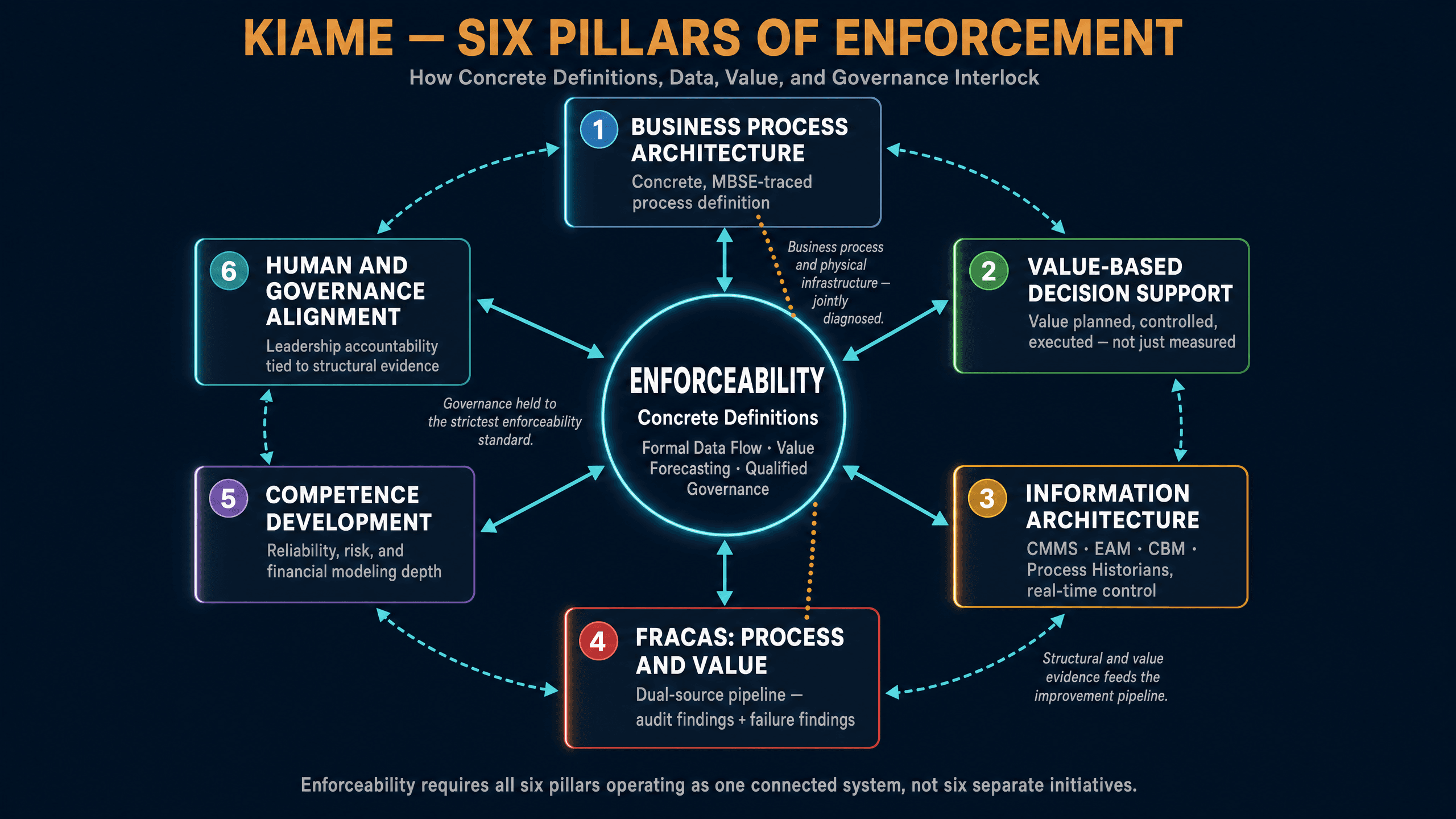
The Six Enforcement Pillars
Built on the three-layer logic, each pillar delivers one or more of the four enforceability conditions in operational practice.
Business Process Architecture & Enforcement
Applies MBSE to produce a concrete, traceable, constraint-validated definition of how work, decisions, and information must flow across the asset lifecycle. Converts vague process intentions into structures that can be audited and enforced.
Formal Value & Decision-Support Architecture
Establishes tool-based decision models connecting every significant asset decision to cost, risk, and performance using stochastic simulation and formal optimization. Value is planned, controlled, and executed — not merely measured after the fact.
Information Architecture for Real-Time Control
Designs the data structures, flows, and views required to reveal — in real time — whether the process defined in Pillar 1 is being followed and whether decisions in Pillar 2 are producing their intended value. Names every system of record explicitly: CMMS, EAM, CBM, Process Historian.
FRACAS Integrated with Process & Value
Applies formal causal analysis on top of the Layer 1 model so every failure is diagnosed with full traceability to functions, components, contracts, and organizational causes. Two entry points — audit-originated and failure-originated findings — feed a single visible improvement pipeline.
Competence Development & Method Enablement
Establishes structured, realistic learning paths for reliability analysis, risk modeling, lifecycle financial evaluation, and formal optimization. Competence is a precondition for enforceability — a concrete definition built by people who do not understand the methods behind it will not survive its first real challenge.
Human & Governance Alignment
Manages cultural gaps, control islands, threat perception, and provider drift. Governance is held to the fourth enforceability condition more strictly than execution: a governor who cannot assess whether a definition is concrete, data flow sufficient, or a result forecast — provides false assurance, not real oversight.
Mapping the Twelve Failure Modes
Every failure mode that undermines asset management deployments maps directly to a KIAME pillar. The framework was built specifically to close these gaps.
KIAME and ISO 55000
ISO 55000 provides valuable overview concepts, terminology, and four fundamentals: value, alignment, leadership, and assurance. The 2024 revision strengthened requirements around decision-making frameworks, risk planning, and data management.
The standard deliberately remains at the management-system level: it requires that a SAMP, a decision-making framework, and top management accountability exist — without mandating the structural modeling methodology or evidentiary basis that would make any of them verifiably credible rather than documented.
KIAME does not replace ISO 55000. It supplies the missing enforcement mechanics for requirements the standard already states but does not know how to make executable. The presence of explicit answers to the four enforceability conditions — not the presence of more documentation, more workshops, or more general commitment — constitutes enforceability.